
Introduction: A Core Reagent in Molecular and Cellular Research
Puromycin is a well-established aminonucleoside antibiotic extensively used in molecular biology, biotechnology, and cell culture research. Its ability to disrupt protein synthesis with high efficiency has positioned it as a key tool in laboratories focused on gene expression, translation analysis, and stable cell line development.
Originally isolated from Streptomyces alboniger, puromycin is widely recognized for its rapid and reliable performance in cell selection systems and protein translation studies. Foundational information on antibiotic mechanisms and translation can be explored through resources such as the National Institutes of Health (https://www.nih.gov/) and the National Center for Biotechnology Information (https://www.ncbi.nlm.nih.gov/), which provide comprehensive scientific insights into molecular processes.
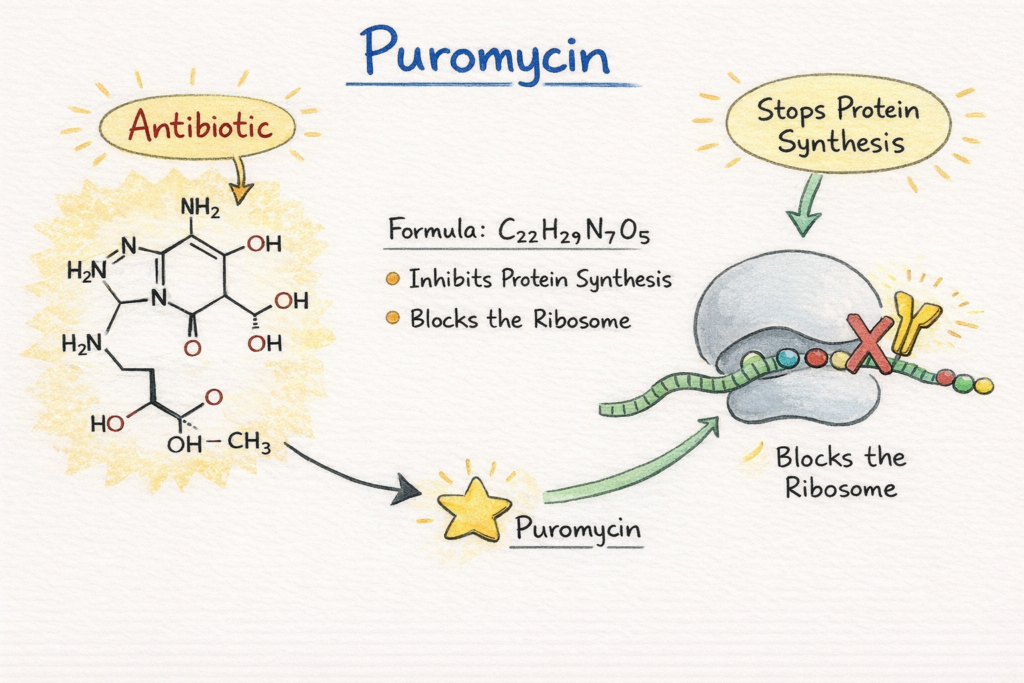
Molecular Mechanism of Puromycin Action
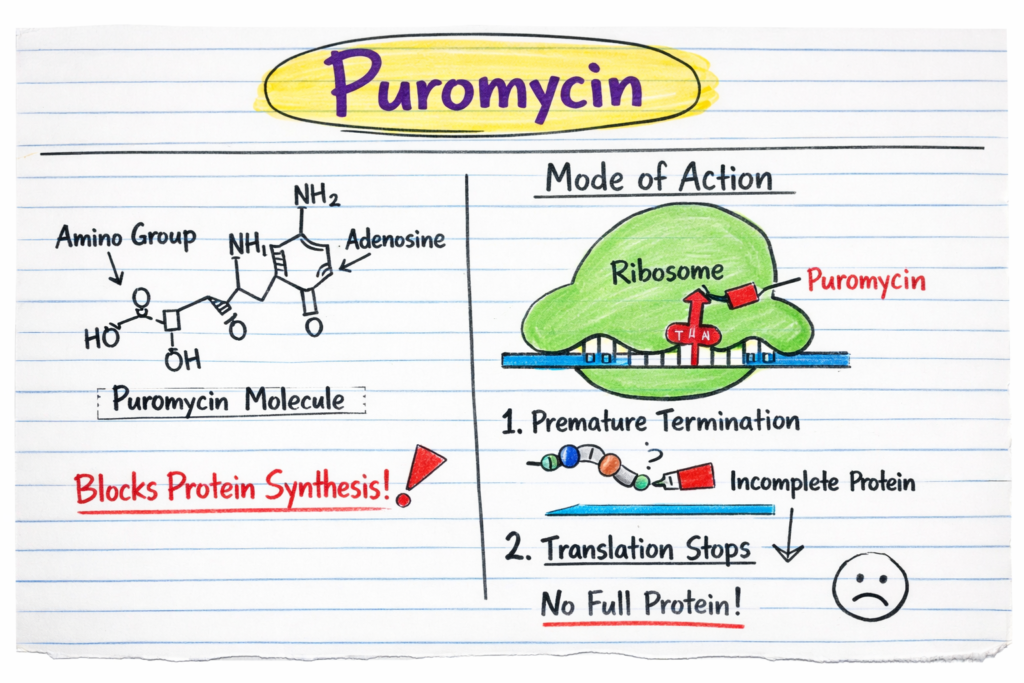
Puromycin acts by mimicking the 3′ end of aminoacylated transfer RNA (tRNA). During translation, it enters the ribosomal A-site and becomes covalently attached to the growing polypeptide chain. This results in premature termination of protein synthesis, releasing incomplete polypeptides.
Detailed molecular insights into ribosomal function and translation can be reviewed in educational resources such as:
-
Ribosome structure and translation overview: https://www.ncbi.nlm.nih.gov/books/NBK26829/
-
Protein biosynthesis fundamentals: https://www.ncbi.nlm.nih.gov/books/NBK9841/
-
Mechanisms of translation elongation: https://www.ncbi.nlm.nih.gov/pmc/articles/PMC2442466/
Additional structural biology perspectives are available via the Protein Data Bank (https://www.rcsb.org/) and the European Bioinformatics Institute (https://www.ebi.ac.uk/), where researchers can explore ribosome–ligand interactions.
Key Applications in Life Science Research
1. Efficient Selection of Genetically Modified Cells
Puromycin is widely used in mammalian cell culture for selecting cells that express a puromycin resistance gene. Only successfully modified cells survive under puromycin pressure, enabling rapid enrichment.
For guidelines on cell culture techniques and antibiotic selection, researchers often consult:
-
NIH cell biology resources: https://www.nih.gov/
-
NCBI cell culture references: https://www.ncbi.nlm.nih.gov/pmc/articles/PMC5027072/
-
National Science Foundation (NSF): https://www.nsf.gov/
2. Analysis of Protein Translation
Puromycin is frequently used in assays that monitor protein synthesis rates, including puromycin-labeling techniques that track nascent polypeptides.
Further reading on translation and gene expression can be found at:
-
Genome Research Institute: https://www.genome.gov/
-
National Library of Medicine: https://www.nlm.nih.gov/
-
University of Utah Genetic Science Learning Center: https://learn.genetics.utah.edu/
3. Functional Genomics and CRISPR-Based Workflows
Puromycin selection is integral to CRISPR and RNA interference workflows, ensuring that only successfully edited or transduced cells are retained.
Educational materials on genome editing and screening technologies include:
-
CRISPR overview (NIH): https://www.genome.gov/genetics-glossary/CRISPR
-
Broad Institute educational resources: https://www.broadinstitute.org/
-
National Human Genome Research Institute: https://www.genome.gov/
4. Drug Discovery and Cellular Response Studies
Puromycin is also applied in studies investigating cellular stress, protein turnover, and translational control mechanisms.
For broader context on molecular biology and cellular pathways:
-
National Institute of General Medical Sciences: https://www.nigms.nih.gov/
-
National Institute of Standards and Technology: https://www.nist.gov/
-
U.S. Department of Energy Office of Science: https://www.energy.gov/science

Advantages of Puromycin in Experimental Systems
Puromycin offers several advantages that make it a preferred reagent in laboratory workflows:
-
Rapid selection: Non-resistant cells are eliminated within a short timeframe
-
High sensitivity: Effective at low concentrations
-
Broad compatibility: Suitable for various eukaryotic cell lines
-
Reliable results: Consistent performance across experiments
Comparative insights into laboratory reagents and experimental reproducibility can be explored through:
-
National Institute on Aging research resources: https://www.nia.nih.gov/
-
National Institute of Environmental Health Sciences: https://www.niehs.nih.gov/
Practical Considerations for Laboratory Use
To maximize performance, researchers typically:
-
Perform dose-response (kill curve) experiments
-
Optimize concentration for each cell type
-
Maintain sterile handling conditions
-
Monitor cell morphology and viability during selection
Standard laboratory practices and biosafety considerations are detailed in:
-
Centers for Disease Control and Prevention (CDC): https://www.cdc.gov/labs/
-
World Health Organization laboratory guidance: https://www.who.int/health-topics/laboratory-services
-
U.S. Food and Drug Administration (FDA): https://www.fda.gov/science-research
Storage, Stability, and Handling
Proper storage ensures consistent reagent performance:
-
Store at -20°C in aliquots
-
Avoid repeated freeze–thaw cycles
-
Protect from moisture and prolonged light exposure
Guidelines on chemical handling and laboratory standards can be found at:
-
Occupational Safety and Health Administration (OSHA): https://www.osha.gov/
-
National Institute for Occupational Safety and Health (NIOSH): https://www.cdc.gov/niosh/
-
Environmental Protection Agency (EPA): https://www.epa.gov/
Expanding Research Opportunities with Puromycin
Puromycin continues to play a central role in advancing research in:
-
Protein synthesis regulation
-
Gene expression analysis
-
Cell engineering and biotechnology
-
High-throughput screening platforms
For additional scientific exploration and datasets:
-
PubMed Central: https://www.ncbi.nlm.nih.gov/pmc/
-
National Center for Biotechnology Information databases: https://www.ncbi.nlm.nih.gov/gene/
-
UniProt protein database (EBI): https://www.uniprot.org/
-
Ensembl genome browser: https://www.ensembl.org/
Conclusion: A Reliable Standard in Molecular Biology Workflows
Puromycin remains one of the most efficient and versatile tools for studying translation and selecting genetically modified cells. Its well-characterized mechanism, rapid action, and adaptability to various experimental systems make it indispensable in modern laboratories.
By integrating puromycin into workflows involving cell culture, genome editing, and protein synthesis analysis, researchers can achieve precise, reproducible, and scalable results across a wide range of applications.
Puromycin antibiotic, puromycin selection marker, puromycin protein synthesis inhibitor, puromycin cell culture selection, puromycin mechanism ribosome, translation inhibition assay puromycin, puromycin resistance gene pac, CRISPR puromycin selection, molecular biology reagents puromycin, cell line selection antibiotic, puromycin laboratory use, protein synthesis research tools