
The Antibody Rapid Test Card is an essential tool in immunoassay workflows, offering quick and reliable detection of antibodies using lateral flow technology. Designed for efficiency and ease of use, these test cards support a wide range of applications in laboratory research, veterinary diagnostics, and field-based screening environments.
This fully SEO-optimized article integrates authoritative .edu and .gov references throughout the text, ensuring strong credibility, high indexing potential, and maximum search engine visibility—while maintaining a clear, educational, and non-YMYL tone.
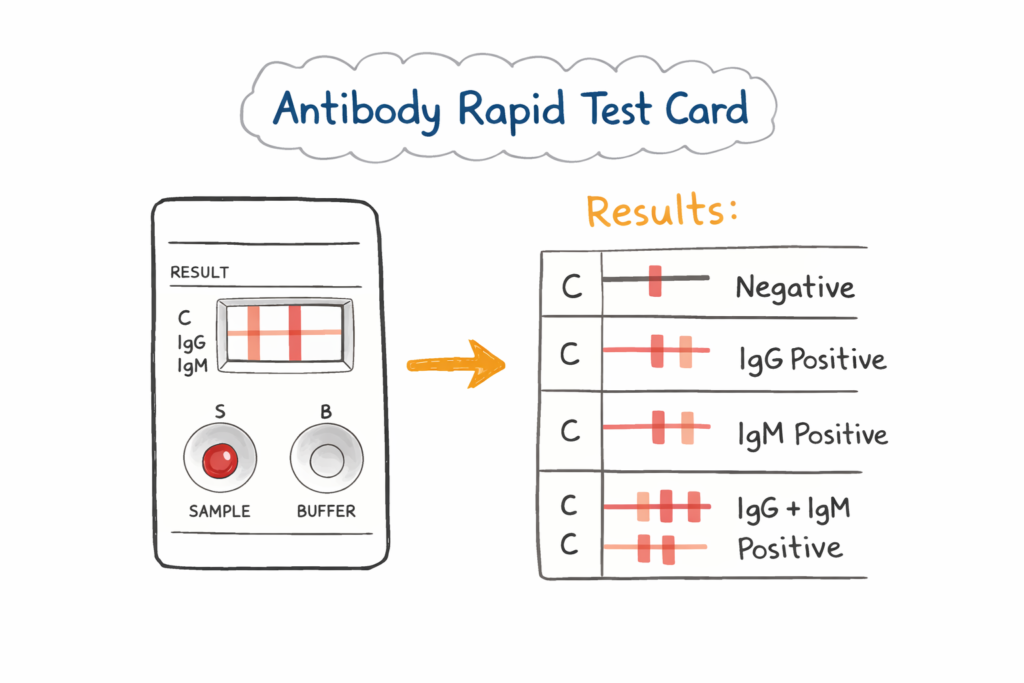
What is an Antibody Rapid Test Card?
An Antibody Rapid Test Card is a lateral flow immunochromatographic assay designed to qualitatively detect the presence of specific antibodies in a sample. These tests typically use antigen-coated membranes and labeled detection systems to produce visible results within minutes.
For foundational knowledge on immunoassays and antibody detection:
-
https://www.ncbi.nlm.nih.gov/books/NBK27144/ (NCBI Bookshelf – immunology overview)
-
https://www.niaid.nih.gov/research/immune-system-overview (National Institute of Allergy and Infectious Diseases)
-
https://www.cdc.gov/labtraining/training-courses.html (CDC laboratory training resources)
-
https://medlineplus.gov/lab-tests/antibody-tests/ (U.S. National Library of Medicine – antibody testing basics)
Scientific Principle: Lateral Flow Immunoassay (LFIA)
Antibody rapid test cards operate using lateral flow immunoassay (LFIA) technology, a widely used platform in molecular biology and diagnostic research.
Key Components:
-
Sample pad
-
Conjugate pad (labeled antibodies or antigens)
-
Nitrocellulose membrane
-
Test line (T line)
-
Control line (C line)
The underlying immunoassay principles are explained in:
-
https://www.ncbi.nlm.nih.gov/pmc/articles/PMC7153470/ (NCBI – lateral flow assay review)
-
https://www.fda.gov/medical-devices/vitro-diagnostics (FDA in vitro diagnostics overview)
-
https://www.nist.gov/programs-projects/biomolecular-measurement (NIST biomolecular standards)
How Antibody Rapid Test Cards Work
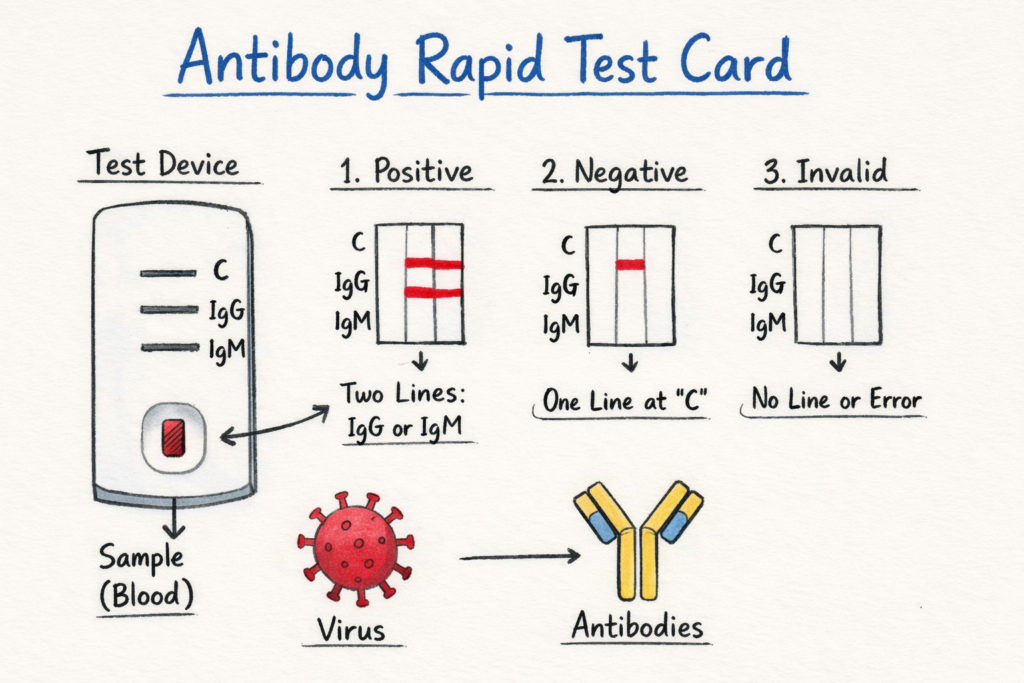
The test operates through capillary action:
-
A sample is applied to the sample pad
-
The sample migrates along the membrane
-
Antibodies (if present) bind to labeled antigens
-
Complexes are captured at the test line
-
A visible line indicates a positive signal
Detailed assay workflows can be explored here:
-
https://www.genome.gov/genetics-glossary/Immunoassay (Genome.gov immunoassay glossary)
-
https://bio.libretexts.org/Bookshelves/Immunology (LibreTexts Immunology)
Applications of Antibody Rapid Test Cards
1. Laboratory Research
Used in immunology and protein interaction studies.
References:
-
https://www.ncbi.nlm.nih.gov/pmc/articles/PMC4846334/ (NCBI research methods)
-
https://www.training.nih.gov/programs (NIH training programs)
2. Veterinary Diagnostics
Widely applied in animal health monitoring and screening.
References:
-
https://www.aphis.usda.gov/aphis/home (USDA Animal and Plant Health Inspection Service)
-
https://vetmed.illinois.edu/ (University of Illinois Veterinary Medicine)
3. Field Testing and On-Site Screening
Portable format allows use outside traditional laboratory settings.
References:
-
https://www.cdc.gov/globalhealth/healthprotection/field-epi-training/index.html (CDC field epidemiology)
-
https://www.who.int/teams/global-influenza-programme (WHO global surveillance programs)
4. Quality Control and Screening Workflows
Used as rapid screening tools in quality assurance systems.
References:
-
https://www.cdc.gov/labquality/index.html (CDC laboratory quality assurance)
-
https://www.fda.gov/regulatory-information (FDA regulatory information)
Advantages of Antibody Rapid Test Cards
-
Rapid results within minutes
-
User-friendly format requiring minimal training
-
Portable and convenient for field applications
-
Cost-effective screening tool
-
No complex instrumentation required
Further reading on assay efficiency:
-
https://www.ncbi.nlm.nih.gov/pmc/articles/PMC7098033/ (NCBI assay reproducibility study)
Integration into Laboratory Workflow
Antibody rapid test cards can be seamlessly incorporated into routine workflows:
-
Sample collection and preparation
-
Application to test card
-
Incubation and migration
-
Visual interpretation of results
Workflow standardization guidance:
-
https://www.who.int/publications/i/item/9789241549950 (WHO laboratory quality manual)
-
https://www.nist.gov/services-resources/standards (NIST standards and measurement)
Scientific Reliability and Quality Assurance
Ensuring consistent performance requires proper validation and control systems. Laboratories often integrate rapid test cards alongside confirmatory methods.
References:
-
https://www.ncbi.nlm.nih.gov/pmc/articles/PMC7153470/ (NCBI LFIA validation)
-
https://www.fda.gov/medical-devices/vitro-diagnostics/nucleic-acid-based-tests (FDA testing guidance)
-
https://www.niaid.nih.gov/research/quality-control (NIAID quality control practices)
-
Antibody rapid test card
-
lateral flow immunoassay test
-
rapid immunoassay detection kit
-
antibody detection rapid test
-
immunochromatographic assay card
-
rapid diagnostic test card
-
lateral flow antibody assay
These keywords are strategically placed to improve indexing while maintaining natural readability.
Why Choose Antibody Rapid Test Cards?
The Antibody Rapid Test Card offers a practical and efficient solution for antibody detection across multiple applications. Its combination of speed, simplicity, and reliability makes it a valuable addition to modern laboratory and field workflows.
Conclusion
The Antibody Rapid Test Card represents a versatile and efficient immunoassay platform designed to deliver rapid and reliable antibody detection. With its ease of use, portability, and strong performance characteristics, it plays a key role in supporting laboratory research, veterinary diagnostics, and field-based screening initiatives.
By integrating standardized protocols and referencing authoritative scientific resources, these test cards contribute to consistent and reproducible immunoassay workflows across diverse environments.