
Introduction: Versatile Detection Technologies for Quantitative Analysis
Colorimetric & Fluorometric Assay Kits are essential tools in molecular biology, biochemistry, and cell-based research. These kits enable accurate detection and quantification of biomolecules such as proteins, enzymes, metabolites, and nucleic acids using either color change (absorbance) or fluorescence emission.
Widely adopted in both academic and industrial laboratories, these assay formats provide flexible, scalable, and reproducible solutions for diverse experimental workflows. Foundational concepts in analytical biochemistry and assay development can be explored through trusted educational resources such as the National Institutes of Health (https://www.nih.gov/) and the National Center for Biotechnology Information (https://www.ncbi.nlm.nih.gov/).
Core Detection Principles
Colorimetric Assays
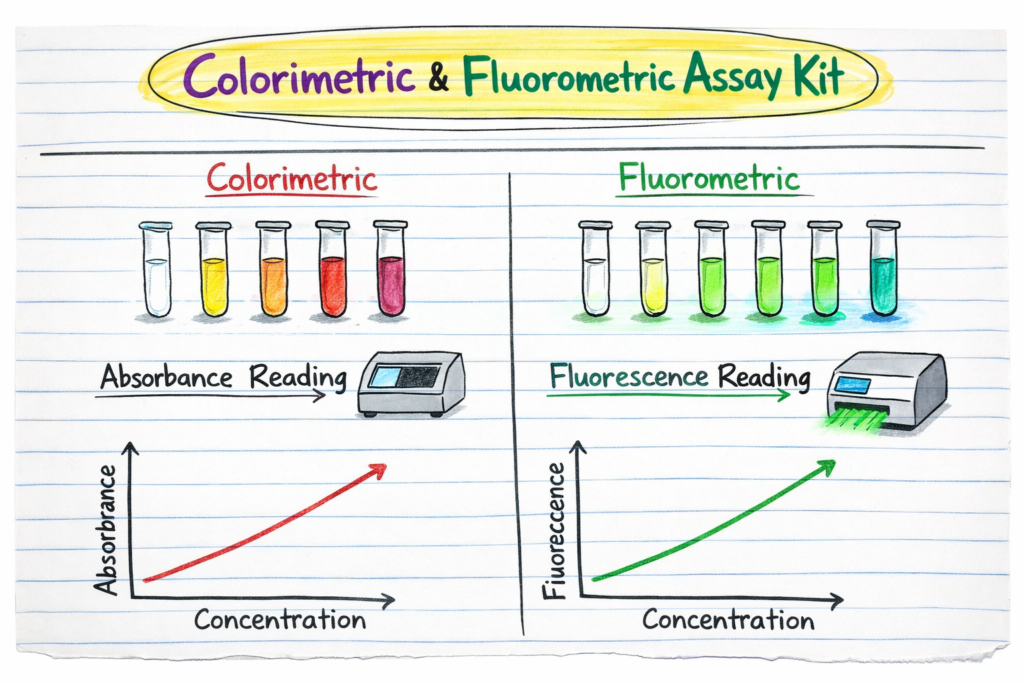
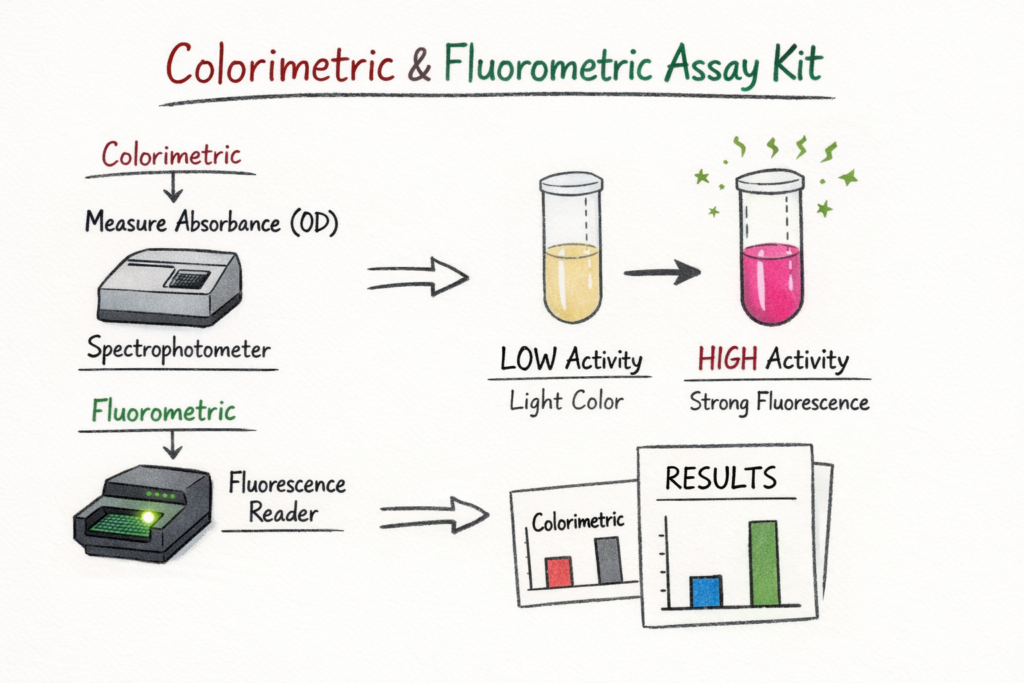
Colorimetric assays rely on enzymatic or chemical reactions that produce a visible color change. The intensity of the color is proportional to the concentration of the target analyte and is measured using a spectrophotometer or microplate reader.
Key principles are described in detail at:
Fluorometric Assays
Fluorometric assays utilize fluorescent probes that emit light upon excitation. These assays are highly sensitive and capable of detecting low-abundance targets with excellent specificity.
Further reading on fluorescence techniques:
Additional insights into spectroscopy and fluorescence can be found at the National Institute of Standards and Technology (https://www.nist.gov/) and the European Bioinformatics Institute (https://www.ebi.ac.uk/).
Key Applications in Life Science Research
1. Enzyme Activity Analysis
Both assay types are widely used to measure enzyme kinetics, substrate conversion, and catalytic efficiency.
Relevant educational resources include:
2. Protein Quantification
Colorimetric assays (such as Bradford or BCA) and fluorometric assays provide reliable quantification of protein concentrations in complex samples.
Supporting references:
3. Cell Viability and Cytotoxicity Studies
Fluorometric and colorimetric assays are frequently used to assess cell health, proliferation, and metabolic activity in response to treatments.
Explore cell biology fundamentals:
4. Metabolite and Biomarker Detection
These assays enable detection of metabolites such as glucose, ATP, lactate, and reactive oxygen species, supporting metabolic and physiological studies.
Further information:

Colorimetric vs Fluorometric Assays: Key Differences
| Feature | Colorimetric Assay | Fluorometric Assay |
|---|---|---|
| Detection Method | Absorbance (color change) | Fluorescence emission |
| Sensitivity | Moderate | High |
| Equipment | Basic plate reader | Fluorescence-capable reader |
| Signal Stability | Generally stable | May require optimization |
| Applications | Routine quantification | Low-abundance detection |
Comparative analytical techniques are discussed by organizations such as:
-
National Science Foundation: https://www.nsf.gov/
-
U.S. Department of Energy Office of Science: https://www.energy.gov/science
Advantages of Combined Assay Kits
Colorimetric & Fluorometric Assay Kits offer dual detection flexibility, allowing researchers to choose the most appropriate method for their experiment.
Key benefits include:
-
Versatility across multiple sample types
-
High sensitivity options with fluorescence detection
-
Ease of use with standardized protocols
-
Scalability for high-throughput screening
-
Compatibility with standard laboratory equipment
Laboratory best practices and assay standardization can be explored at:
Experimental Workflow Overview
A typical assay workflow includes:
-
Sample preparation
-
Reagent addition
-
Incubation period
-
Signal detection (absorbance or fluorescence)
-
Data analysis and quantification
Guidance on experimental design and reproducibility:
Storage and Handling Recommendations
To maintain assay performance:
-
Store kits at recommended temperatures (commonly 4°C or -20°C)
-
Protect fluorescent reagents from light exposure
-
Avoid contamination through sterile handling
-
Follow manufacturer protocols carefully
Safety and laboratory standards:
Expanding Research Capabilities
These assay kits are widely used in:
-
Drug discovery and screening platforms
-
Cell signaling pathway analysis
-
Metabolic profiling
-
High-throughput laboratory workflows
Additional scientific databases and tools:
Conclusion: A Flexible Solution for Quantitative Biology
Colorimetric & Fluorometric Assay Kits provide a powerful combination of simplicity and sensitivity, enabling researchers to perform accurate and reproducible measurements across a wide range of biological applications. Their adaptability makes them an essential component of modern laboratory workflows.
Colorimetric assay kit, fluorometric assay kit, enzyme activity assay, fluorescence detection assay, absorbance assay kit, protein quantification assay, cell viability assay kit, biochemical assay kits, laboratory detection methods, fluorescence microplate assay, colorimetric vs fluorometric assays, high sensitivity assay kits